

The Conference Overview
The 6th International Conference on Language Studies, Translation and Education (ICLTE 2026), held from February 5–7, 2026, has officially set a new benchmark for international academic synergy.
Coordinated across major hubs in Bursa (Türkiye) and Lahore (Pakistan), the event transitioned from a traditional conference into a dynamic “interactive platform,” proving that geographic and political boundaries are no match for shared scientific intent.
A Triad of Excellence: Ukraine, Pakistan, and Türkiye
One of the most profound takeaways from ICLTE 2026 was the visible strength of the “Academic Axis” connecting Vadym Hetman Kyiv National Economic University (KNEU), the University of Management and Technology (UMT) Lahore, and IATELS supported by STARTINFORUM.
Despite global challenges, the delegation from KNEU (Kyiv, Ukraine), led by figures such as Dr. Tetiana Fursenko and Dr. Olena Tsyrkun, presented a masterclass in professional resilience.
Their sessions showcased how language education remains a strategic tool for student entrepreneurship and national identity even in times of crisis.
We would like to express our sincere gratitude for the opportunity to contribute to the discussion of topical issues related to education and language learning with AI on such a prestigious international platform.
It was an unparalleled experience that our participants greatly enjoyed.
We are also very grateful for your understanding and flexibility in handling the technical issues that prevented our participants from presenting their project live.

I would like to express my sincere appreciation to the IATELS team for the excellent organisation of ICLTE 2026 and for inviting me to participate as a speaker.
Thank you once again for your professionalism and support.
I look forward to partnering up with your institution.

The presence of KNEU at ICLTE 2026 was a cornerstone of the conference’s success. We were particularly impressed by:
– The Excellence of Your Scholars: The highly professional presentations delivered by your faculty members set a remarkable academic standard. Their insights into the intersection of economics, language, and modern education were invaluable to our global audience.
– Impeccable Organization: We would like to commend the leadership for the seamless coordination of your speakers. The dedication shown in preparing such rigorous and thought-provoking material, despite current challenges, is a testament to the resilient spirit of your institution.
– Scientific Depth: Your contributions significantly enriched our discussions on digital transformation and pedagogical innovation, ensuring that ICLTE remains a premier platform for meaningful academic exchange.

The Main Theme: Moving “Beyond Technological Determinism”
As the conference program reveals, 2026 was the year ICLTE moved past the “fear of AI” and into the realm of Human-Centred AI Integration. Key discussions led by global experts like Prof. Dr. Piet Kommers (Netherlands) emphasized that while AI is a “blessing,” it requires a robust framework of Metacognitive Skills.
Key Research Highlights included:
- AI-Enhanced Pedagogy: From GPT-4.5 interventions in IELTS writing to fighting AI-generated responses through reflective philosophy tasks.
- Minority Language Revival: A groundbreaking case study by Khalid Mahmood (Tamgha-i-Imtiaz) on using AI to revive the Punjabi language across the Pakistan-India border.
- The ESP/EAP Evolution: KNEU and Taras Shevchenko National University scholars demonstrated how AI tools are now integral to English for Specific Purposes (History, Economics, and Tourism).
A Platform for Future Projects, Not Just Presentations
In line with the IATELS mission, ICLTE 2026 functioned as an incubator for future collaboration.
The Session Chairs, including Assoc. Prof. Dr. Asma Kazi and Dr. Mohamed Brahmi, were tasked not just with timing, but with “initiating ties for future research.”
The conference successfully moved beyond “passive listening” to include interactive feedback sessions, where initial plans for joint programs and partnerships were first proposed among the Turkish, Ukrainian, and Pakistani delegates.
Psychosemiotics and Cultural Identity
The third day of the conference delved deep into the “Human Soul” of language. Topics ranged from Gynocritical studies of Pakistani literature to Psychosemiotic analyses of Jane Austen adaptations. This highlighted the unique ICLTE “Multimodal” approach—viewing language not just as text, but as a complex web of media, emotions, and social identity.
Conclusion: The IATELS 2026–2030 Vision
As Prof. Dr. Iryna Sekret outlined in her plenary address, ICLTE 2026 serves as the launchpad for the IATELS Strategic Priorities (2026–2030). The conference proved that the future of education is:
- AI-Supported but Human-Centric.
- Multimodally Aware.
- Economically Integrated (linking language skills to entrepreneurial success).
IATELS and STARTINFORUM extend their gratitude to all participants from Algeria, Uzbekistan, Kosovo, Italy, the USA, and beyond for making this “international team” a reality.


ICET 2026
8th International Conference on Education, Technology and AI Implementation
- 28 – 30 April, 2026
- Conference Focus – EdTech Evolution: Fostering Transformative Perspectives
- Leading Organisation: Curtin University (Perth, Australia), KNEU (Kyiv, Ukraine)
- Abstract Book – Conference Proceedings – Monograph
- 10 April, 2026 – Abstract Submission and Registration Deadline
APBM 2026
7th International Conference on Applied Psychology and Business Management
- 22 – 24 October, 2026
- Conference Focus – Sustainable Futures: Innovating For a Resilient World
- Leading Organisation: Curtin University (Perth, Australia)
- Abstract Book – Conference Proceedings – Monograph
- 01 October, 2026 – Abstract Submission and Registration Deadline
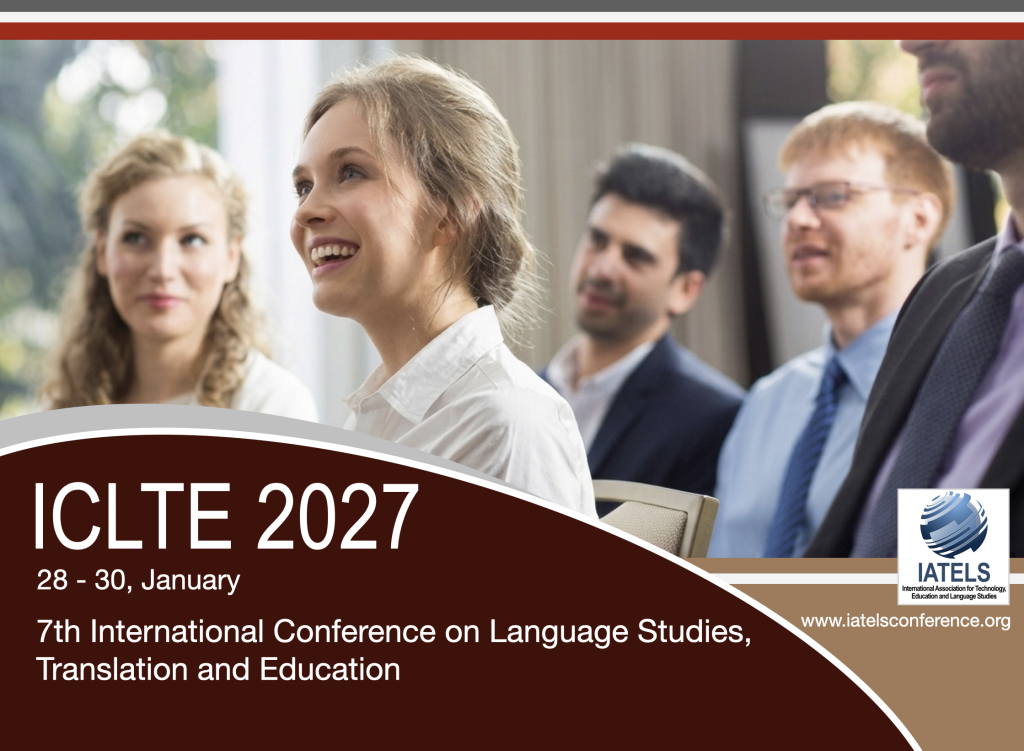
ICLTE 2027
7th International Conference on Language Studies, Translation and Education
- 28 – 30 January, 2027
- “Language as a Bridge in Cultivating Global Cohesion and Intercultural Harmony“
- Leading Organisation: University of Management and Technology (Lahore, Pakistan)
- Abstract Book – Conference Proceedings – Monograph
- 10 January, 2027 – Registration Deadline
Read More About ICLTE 2026
- ICLTE 2026 Program Announced https://iatelsconference.org/index.php/iclte-2026-program-announced/
- Bringing Innovation and Humanity: ICLTE 2026 Launch – https://iatelsconference.org/index.php/2026/02/09/bringing-innovation-and-humanity/
- ICLTE 2026: Where Cultural Heritage Meets the AI Frontier – https://iatelsconference.org/index.php/2026/02/09/iclte-2026-where-cultural-heritage-meets-the-ai-frontier/
- ICLTE 2026: Resilience, Ethics and the Human Dimention of the Digital Age – https://iatelsconference.org/index.php/2026/02/10/iclte-2026-resilience-ethics-and-the-human-dimension-of-the-digital-age/
- ICLTE 2026: Navigating the Intersection of Artificial Intelligence, Gender, and Cultural Identity in Language Education – https://iatelsconference.org/index.php/2026/02/11/iclte-2026-navigating-the-intersection-of-artificial-intelligence-gender-and-cultural-identity-in-language-education/
- ICLTE 2026: Balancing Hyperreality, AI Ethics and Human Centric Pedagogy – https://iatelsconference.org/index.php/2026/02/13/iclte-2026-balancing-hyperreality-ai-ethics-and-human-centric-pedagogy/
- From LASTE to ICLTE: The Evolution of a Global Academic Mission (2018–2026) https://iatelsconference.org/index.php/2026/02/09/from-laste-to-iclte-the-evolution-of-a-global-academic-mission-2018-2026/
- Research at +1° C: The Unspoken Reality of Ukrainian Academia at ICLTE 2026 https://iatelsconference.org/index.php/2026/01/31/research-at-1-c-the-unspoken-reality-of-ukrainian-academia-at-iclte-2026/