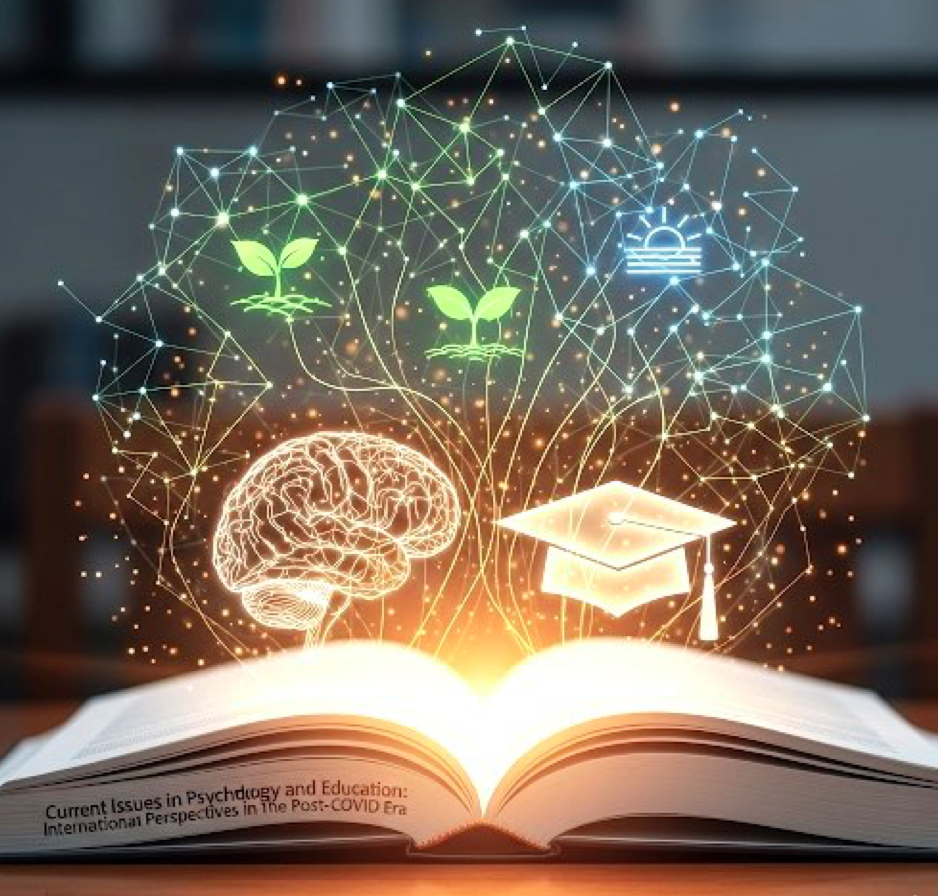
The Book “Current Issues in Psychology and Education: International Perspectives in the Post-COVID Era”, 2023 Published
Overview of the Book
- Title: Current Issues in Psychology and Education: International Perspectives in the Post-COVID Era
- Scientific Editor: Prof. Dr. Iryna Sekret (IATELS Committee Chair, Turkey)
- Publisher & Year: STARTINFORUM, 2023 (Turkey)
- ISBN: 978-605-68986-2-4
- Page Count: 142 pages
- Origin: Collective monograph featuring selected studies presented at ICPATME 2022 (IV International Conference on Pedagogical Advances in Technology-Mediated Education), held at Akdeniz University in Antalya, Turkey (May 27–28, 2022), organized by IATELS and sponsored by STARTINFORUM.
Core Theme & Focus
The book addresses the profound transformations, challenges, and adaptation strategies across global educational and psychological spheres following the COVID-19 pandemic and global lockdowns.
It emphasizes how educational institutions and mental health systems were forced into immediate adaptations—such as emergency remote education (ERE), online language learning, and remote psychological counseling.
By featuring empirical and theoretical research from Turkey, Mexico, India, Morocco, and Nigeria, the volume highlights cross-cultural perspectives on technology adoption, digital divides, psychometrics, and student/teacher behaviors.
Summery of Chapters
Chapter 1: Transformations of Online Education in the Post Pandemic Era
- Authors: Suresh Kashinath Ghatge & Anuradha Parasar (India)
- Summary: Analyzes how COVID-19 forced a massive digital shift in Indian education. Utilizing the Technology Acceptance Model (TAM) and Connectivism Learning Theory, the authors discuss the expansion of ICT tools (smartphones, laptops, smartboards), governmental initiatives (DIKSHA, SwayamPrabha), and key barriers like technical literacy gaps and uneven access to devices between urban and rural populations.
Chapter 2: Technology, Psychology and Education in Mexico: A Psychosocial Analysis
- Authors: Javier Zavala Rayas, Georgina Lozano Razo, & Jorge Mendoza García (Mexico)
- Summary: Examines the complex psychosocial dynamic of Mexican education amid digital shifts. The authors critique structural inequalities, lack of basic infrastructure, and severe digital divides in marginalized and rural regions (e.g., Guerrero, Oaxaca, Chiapas), while discussing soft/hard skills required for teachers adapting to new virtual spaces.
Chapter 3: Alternative Online English Training in the Time of the Global Lockdown: Constructivism in Action (English IATELS Case Study)
- Author: Iryna Sekret (Turkey)
- Summary: Explores a constructivist online English teaching initiative launched during lockdown by the English IATELS Academy (“Learn to Speak with All the World”). Details strategies for creating collaborative, multicultural learning environments that sustain student motivation across diverse international cohorts.
Chapter 4: Psychometric Analysis of the Learned Helplessness Scale Applied to Indian Students
- Author: Sakshi Bhalgat (India)
- Summary: Validates Quinless and Nelson’s 20-item “Learned Helplessness Scale” (LHS) among 312 Indian students. Emphasizes the need to diagnose and address learned helplessness in students facing severe academic and personal stress.
Chapter 5: Investigation of the Change of Pre-Teachers’ Gaming Habits in the COVID-19 Pandemic
- Authors: Ali Özkaya & Gözdegül Arık Karamık (Turkey)
- Summary: A quantitative screening study on 249 pre-service teachers at Akdeniz University. Reveals an increase in online strategy/war gaming post-pandemic driven by isolation, boredom, and anxiety, while highlighting pre-service teachers’ perspectives on integrating games into pedagogy.
Chapter 6: Psychometric Analysis of Applying Short Health Anxiety Illness Scale to Indian Population
- Authors: Darshita Mehta & Madhura Londhe (India)
- Summary: Evaluates the Short Health Anxiety Inventory (SHAI) on 213 Indian participants via an online survey. Demonstrates high reliability ($\alpha = 0.868$), confirming its utility as a diagnostic tool for post-pandemic health anxiety.
Chapter 7: Barriers to Speaking English Fluently: A Case Study
- Author: Olajumoke Elizabeth Ajala (Nigeria)
- Summary: Focuses on university students at Üsküdar University (Turkey) who struggle with English fluency. Identifies key psychological factors and vocabulary constraints, providing practical recommendations for enhancing speaking confidence.
Chapter 8: Students’ Insights Towards the Role of Motivation and Attitude in EFL in the Moroccan University
- Authors: Rym Asserraji, Youssef Aboudi, & Aahd Asserraji (Morocco)
- Summary: Investigates English language learning attitudes among students at Moulay Ismail University. Highlights how positive attitudes, integrative/instrumental motivation, and active practice inside and outside the classroom directly impact language acquisition.
Chapter 9: The Paradoxes of Online Multicultural Counseling: Challenges and Opportunities
- Authors: Evrim Çetinkaya-Yıldız & Dilara Özel (Turkey)
- Summary: Examines the rise of cyber-counseling during the pandemic. Discusses the ethical imperatives, social justice issues, and accessibility barriers (such as the digital divide affecting millions of students worldwide) in providing online multicultural counseling to vulnerable groups.
Chapter 10: Lessons Learnt in COVID-19 Era
- Author: İlknur İstifçi (Turkey)
- Summary: Reflects on Emergency Remote Education (ERE) in higher education. Highlights the abrupt transition shocks experienced by faculty and students, offering strategies for course design, digital skill improvement, and maintaining well-being in online environments.
Key Takeaways & Significance
Lessons for the Future: Recommends hybrid models, continuous digital skills training for educators, constructivist online environments, and enhanced mental health support systems across academic institutions globally.consectetur. Vestibulum auctor felis eget orci semper vestibulum.
Intersection of Psychology & Pedagogy: Demonstrates that technological transitions cannot succeed through infrastructure alone; student mental health, teacher attitudes, and psychological diagnostic tools are critical components.
Global Inequalities & Social Justice: Highlights how the “digital divide” exacerbates social exclusion, leaving rural and economically disadvantaged students at risk during remote transitions.
Lorem ipsum dolor sit amet, consectetur adipiscing elit. Sed imperdiet libero id nisi euismod, sed porta est consectetur. Vestibulum auctor felis eget orci semper vestibulum. Pellentesque ultricies nibh gravida, accumsan libero luctus, molestie nunc.