
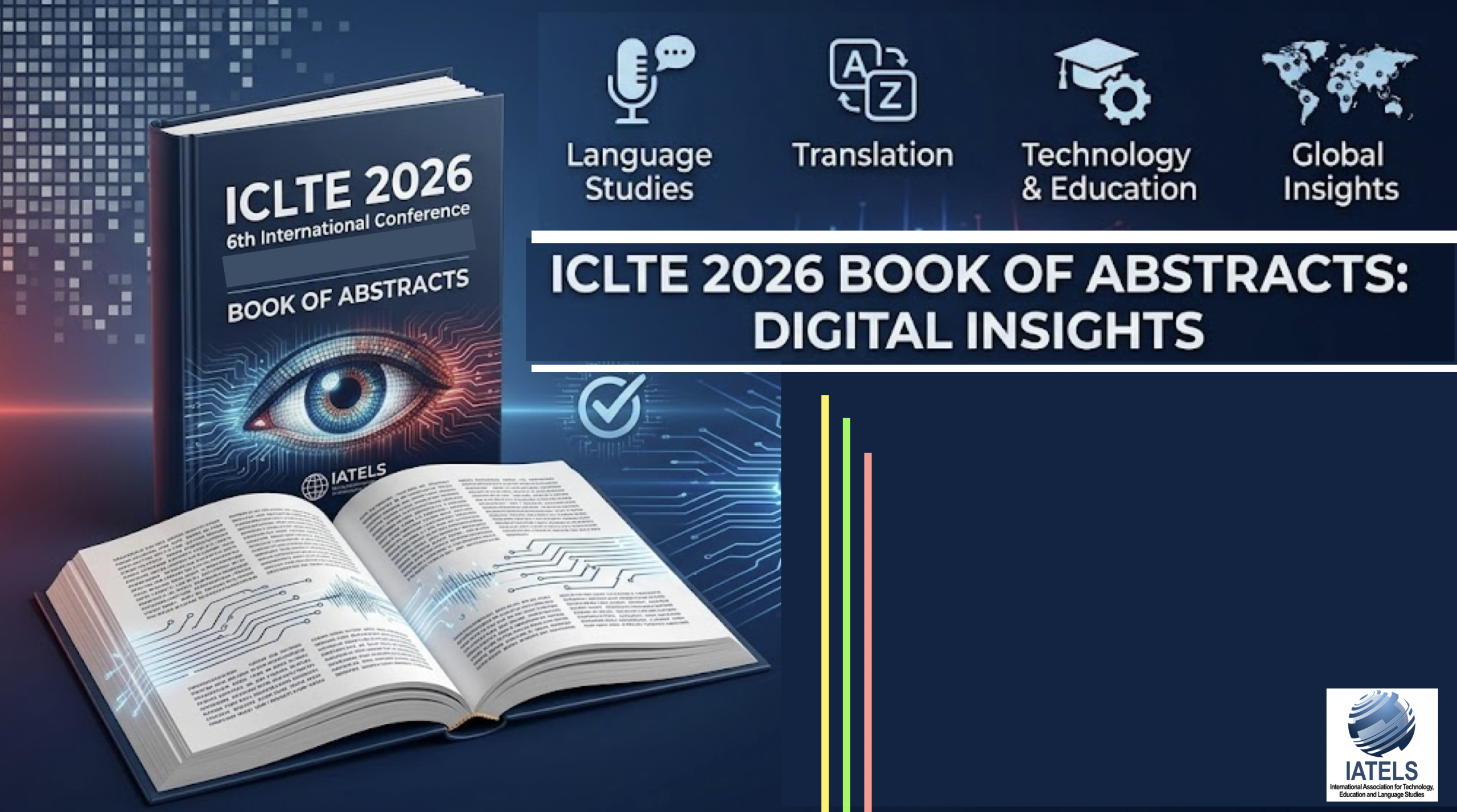
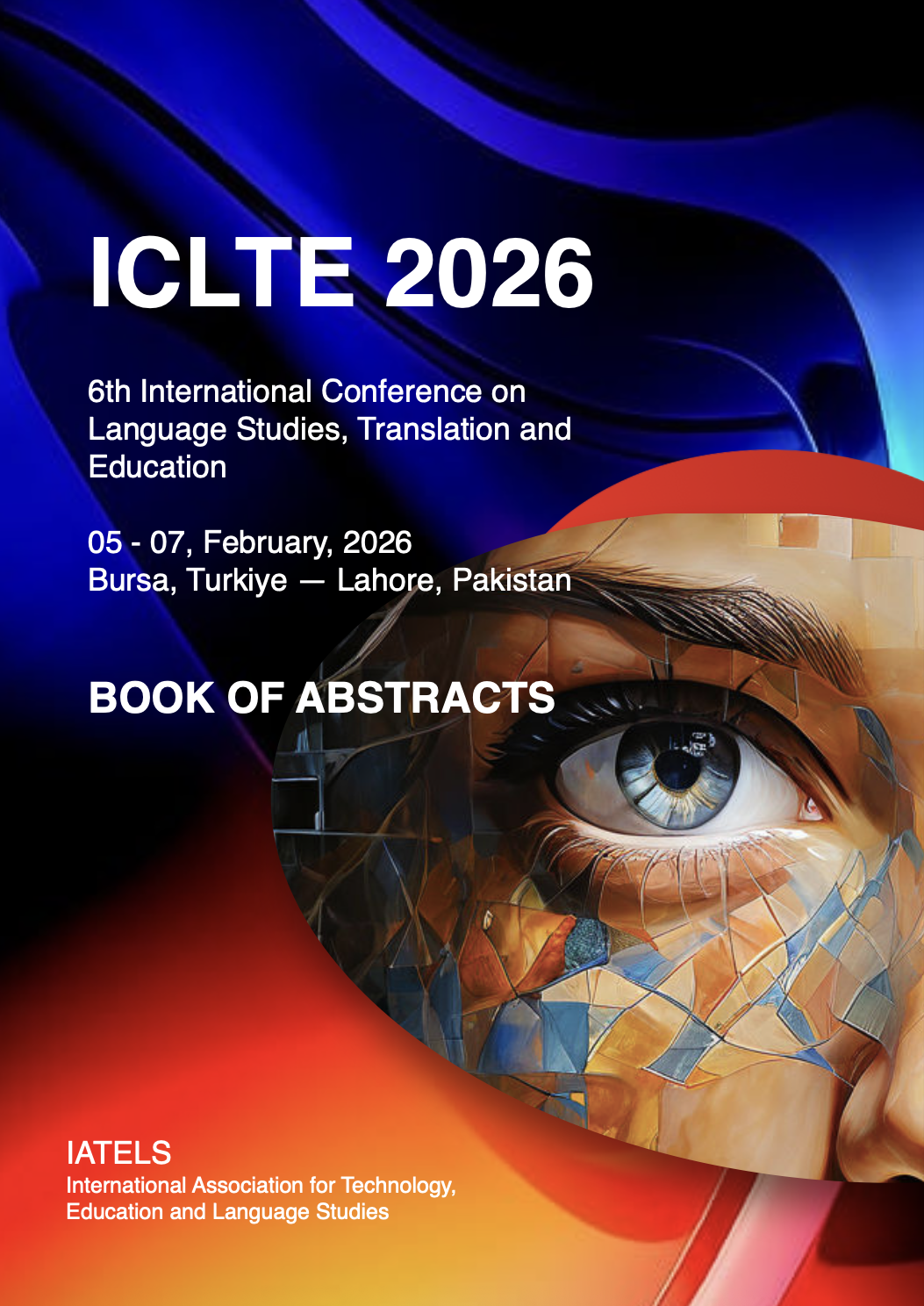
The Organizing Committee of the International Association for Technology, Education and Language Studies (IATELS) is proud to announce the official publication of the Book of Abstracts for the 6th International Conference on Language Studies, Translation and Education (ICLTE 2026).
Edited by Prof. Dr. Iryna Sekret (IATELS Committee Chair) and Prof. Dr. Nadia Anwar (Dean, University of Management and Technology, Pakistan), this comprehensive, 84-page compendium documents the groundbreaking research, active debates, and strategic visions shared during the international event held from February 05–07, 2026.
Metadata & Bibliographic Profile
-
Title: Book of Abstracts – ICLTE 2026: 6th International Conference on Language Studies, Translation and Education
-
Conference Dates: February 05–07, 2026
-
Venues & Organization: Held online, bridging critical academic hubs in Bursa, Turkiye, and Lahore, Pakistan. Organized by the International Association for Technology, Education and Language Studies (IATELS) in collaboration with STARTINFORUM (Turkiye) and the University of Management and Technology (Lahore, Pakistan).
-
Scientific Editors: Prof. Dr. Iryna Sekret (STARTINFORUM, IATELS Committee Chair, Turkiye) and Prof. Dr. Nadia Anwar (University of Management and Technology, Pakistan).
-
Scope: 84 pages containing double-blind peer-reviewed abstracts from scholars representing over 15 countries, including Turkiye, Ukraine, Uzbekistan, Pakistan, Kosovo, the Netherlands, Algeria, the UK, Malaysia, Italy, Iran, Ethiopia, and the USA.
- ISBN: ‘978-625-93229-2-6’
Structural Layout
The volume is organized into seven distinct structural components:
-
Introductory / Editorial Declarations: Outlines the quality assurance process, peer-review standards, and institutional frameworks.
-
About ICLTE 2026: A conceptual review framing the event under the theme “A Global Milestone in Academic Resilience and AI Innovation.”
-
Committee & Partners: Documentation of the scientific committee and strategic alliances (including Springer, English IATELS, and KNEU).
-
Sponsor Profile: Features STARTINFORUM, outlining its corporate milestones (2018–2026) and its role in coordinating flagship tracks like ICLTE, ICET, and APBM.
-
English IATELS Welcome: A greeting detailing the “English Without Borders” methodology, highlighting personalized, AI-supported, and psychologically grounded English language training.
-
Conference Program: A chronological schedule spanning three days of concurrent plenary and academic sessions.
-
Thematic Abstracts: The primary compendium of abstracts mapping out the core research pillars.
Core Research Pillars & Themes
The abstracts within the volume converge on three primary fields of inquiry:
-
Human-Centered AI Integration: Moving past “technological fear” to address generative AI ($\text{GenAI}$) tools like $\text{GPT-4.5}$ and chatbots. This tracks shifts from passive knowledge transmission to fostering metacognitive skills, critical AI literacy, and reflective philosophy tasks designed to preserve human originality against AI-generated text.
-
Academic Resilience & Transnational Collaborations: Highlighting the “Academic Axis” connecting Turkiye, Pakistan, and Ukraine. It features studies from institutions operating under active crisis zones (such as Kyiv National Economic University and Taras Shevchenko National University of Kyiv), proving that language education serves as a strategic asset for national identity and entrepreneurial lifeline during times of instability.
-
Sociolinguistics, Gender, and Multimodal Discourses: Academic investigations exploring the psychosemiotic analysis of media adaptations, gynocritical studies of regional literature, lingual expressions of gender bias in mass media, and AI-driven minority language revival (e.g., the digital vitality of the Punjabi language across borders).
Connecting Academic Hubs Across Global Divides
ICLTE 2026 successfully established a new paradigm for international scholarly collaboration. By connecting major academic hubs in Bursa (Türkiye) and Lahore (Pakistan), the online event transcended traditional conference boundaries, evolving into a high-intensity “interactive platform” that unified diverse scientific intents across geographic and political divides.
The newly released volume showcases double-blind peer-reviewed contributions from scholars spanning more than 15 countries—including Italy, Ukraine, Uzbekistan, Kosovo, Algeria, The Netherlands, Malaysia, Iran, Ethiopia, and the USA. It serves as a monumental testament to what the editorial board describes as the “Academic Axis”—a triadic alliance between IATELS, the University of Management and Technology (UMT), and Kyiv National Economic University named after Vadym Hetman (KNEU), supported by the conference’s strategic sponsor, STARTINFORUM.
Overcoming Crisis Through “Academic Resilience”
A defining highlight captured within this publication is the profound professional resilience of the Ukrainian academic delegation. Faced with immense regional instabilities, scholars from KNEU and Taras Shevchenko National University of Kyiv contributed seminal frameworks demonstrating that language education is far more than a skill—it is a vital infrastructure for student entrepreneurship, national identity, and socio-economic survival during times of crisis.
The AI Frontier: From “Technological Fear” to Human-Centered Integration
At the heart of the ICLTE 2026 proceedings is a collective push toward Human-Centered AI Integration. Moving decisively past technological determinism, the featured papers explore how educators can transition from passive language transmission into roles as “pedagogical architects.”
Key technological areas explored in the abstracts include:
-
Metacognitive Skills over Automation: Spearheaded by insights from Prof. Dr. Piet Kommers (The Netherlands), papers detail how to ground AI usage in metacognitive awareness so that technology acts as a cognitive partner rather than a human replacement.
-
Combating AI Content with Reflective Pedagogy: Innovative methodologies showcase how to design personalized, reflective tasks in academic writing to preserve an author’s unique voice and neutralize automated text generation.
-
AI-Driven Language Revival: Groundbreaking case studies, such as the text-centric language technology initiatives presented by Khalid Mahmood (Tamgha-i-Imtiaz), highlight how AI can actively revitalize low-resource minority languages like Punjabi across borders.
-
The Evolution of ESP/EAP: Practical applications showing how AI tools and embedded quizzes are being strategically woven into English for Specific Purposes (ESP) for fields like Economics, History, and Tourism Management.
Deepening the “Human Dimension”
The publication also brings forward essential discussions on the socio-emotional fabric of language. Through the critical lenses of psychosemiotics and gynocriticism, researchers explore the representation of emotions in digital media, the structural expressions of gender bias in mass media, and the psychological health of women in regional literature. These studies reinforce the core ICLTE philosophy: language remains a complex matrix of emotion, media, and social identity that technology must support, not replace.
Charting the Path to 2030
As outlined in Prof. Dr. Iryna Sekret’s plenary address, the insights compiled in this book will serve as the foundation for the IATELS 2026–2030 Strategic Priorities. The roadmap firmly establishes that the global future of language education must be:
-
AI-Supported yet Human-Centric
-
Multimodally Aware across all changing digital landscapes
-
Economically Integrated, directly bridging linguistic proficiency with global professional mobility and entrepreneurial success
Accessing the Publication
The ICLTE 2026 Book of Abstracts stands as an invaluable reference tool for researchers, practitioners, curriculum developers, and policymakers eager to navigate the intersection of humanity, language, and artificial intelligence.
To review the full program, read the corporate and editorial welcomes from STARTINFORUM and English IATELS, or explore the individual research abstracts, visit IATELS Association Hub: www.iatels.com | www.iatelsconference.org
The Organizing Committee extends its deepest gratitude to all session chairs, scientific reviewers, and international delegates who transformed this shared academic vision into a resilient reality. Selected high-impact papers from the event are currently undergoing secondary review for the upcoming Springer Monograph project.

APBM 2026
7th International Conference on Applied Psychology and Business Management
- 22 – 24 October, 2026
- Conference Focus – Sustainable Futures: Innovating For a Resilient World
- Leading Organisation: Curtin University (Perth, Australia)
- Abstract Book – Monograph
- 01 October, 2026 – Abstract Submission and Registration Deadline
ICLTE 2027
7th International Conference on Language Studies, Translation and Education
- 28 – 30 January, 2027
- “Language as a Bridge in Cultivating Global Cohesion and Intercultural Harmony“
- Leading Organisation: University of Management and Technology (Lahore, Pakistan)
- Abstract Book – Monograph
- 10 January, 2027 – Registration Deadline
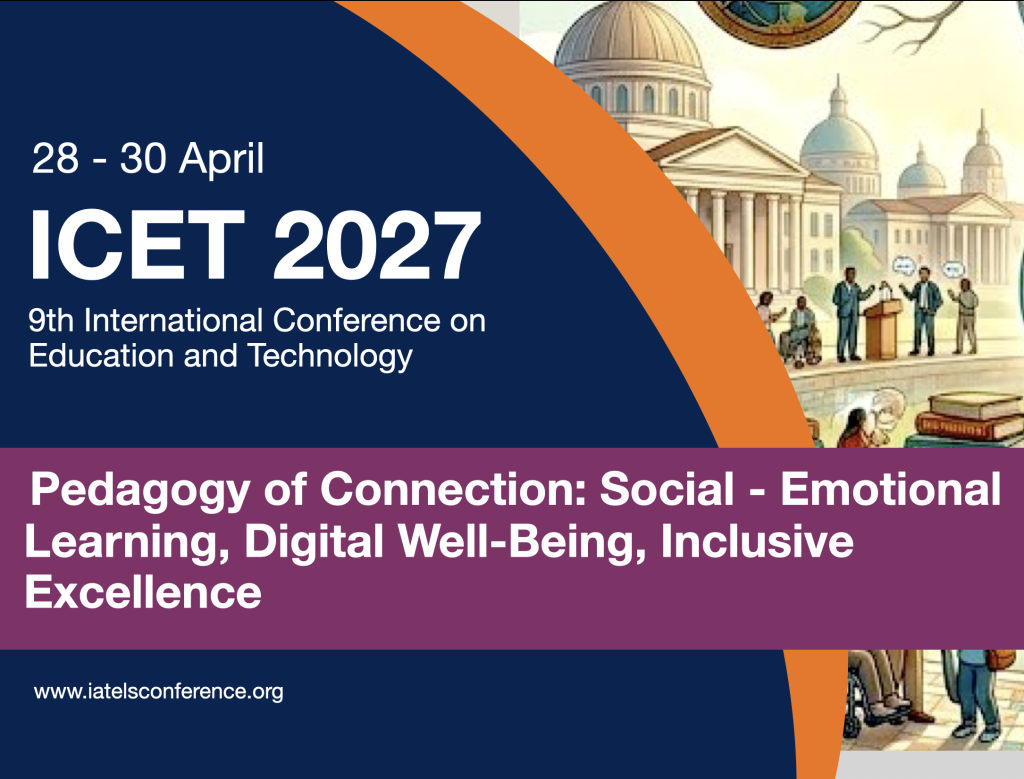
ICET 2027
9th International Conference on Education and Technology
- 28 – 30 April, 2027
- Conference Focus – Pedagogy of Connection: Social-Emotional Learning, Digital Well-Being and Inclusive Excellence
- Leading Organisation: Curtin University (Perth, Australia), KNEU (Kyiv, Ukraine)
- Abstract Book – Monograph
- 10 April, 2027– Abstract Submission and Registration Deadline