

Bridging Continents and Disciplines: A Reflective Review of the APBM 2025
6th International Conference on Applied Psychology and Business Management
The 6th International Conference on Applied Psychology and Business Management (APBM 2025) successfully concluded its two-day online program on October 16th and 17th, transforming the virtual space into a dynamic, cross-cultural incubator for innovation.
Uniting academicians and practitioners from around the globe, the conference definitively achieved its primary goal: establishing an interactive, productive, and truly international platform for deep collaboration across Psychology, Business Management, Social Sciences, Education, Technology, and Research.
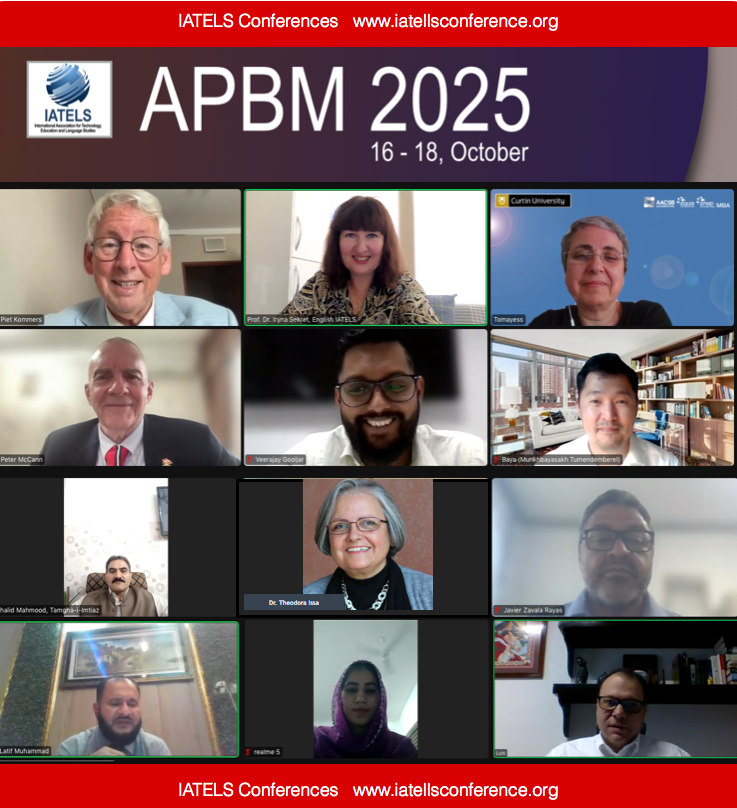
The APBM Difference: Interaction as the Core Mandate
The core value proposition of APBM 2025 was its commitment to genuine engagement.
Rejecting the traditional, rushed format, the conference allocated a generous 30 minutes per speaker, deliberately reserving at least 10 minutes for questions, discussions, and reflections.
This format proved instrumental, allowing participants not only to fully present their work but also to receive constructive, multidisciplinary feedback.
The mandate for all attendees to be active with questions and reflections ensured that every presentation became a fertile ground for identifying research gaps and establishing meaningful, future-focused connections.
Day 1 Reflections: Technology, Strategy, and the Sustainable Future
Plenary Session Highlights (10:00 – 13:00)
The conference opened with a distinguished Plenary Session, officially inaugurated by Conference Chair Dr. Tomayess Issa (Curtin University, Australia).
Following the opening, Prof. Dr. Iryna Sekret (IATELS Committee Chair, Turkey) set the historical and structural context in her speech, APBM 2025: A Retrospective on Six Years of Interdisciplinary Growth.
Professor Sekret detailed the conference’s genesis as a necessary response to academic isolation, championing an interconnected approach between Applied Psychology and Business Management. She chronicled APBM’s evolution:
- Years 1 & 2 (The Founding Phase): Focused on establishing the core interdisciplinary dialogue and perfecting the unique 30-minute interactive speaker slot.
- Years 3 & 4 (The Expansion Phase): Saw the crucial incorporation of Social Sciences, Education, Technology, and Research Methodologies as unifying threads.
- Years 5 & 6 (The Global Integration Phase): Marked by profound international diversification and a focus on global-application-oriented topics.
This retrospective underscored the commitment to creating an international platform for creating opportunity, urging attendees to treat the sessions as an ecosystem for designing the collaborative projects of tomorrow.
The keynote addresses immediately set an advanced, interdisciplinary tone:
- Prof. Dr. Piet Kommers (University of Twente, Netherlands) tackled the critical future of education in his session on AI in Developing Entrepreneurship and Critical Thinking Skills. His reflection centered on the idea that AI should not replace, but rather challenge human students, forcing them to develop higher-order thinking necessary for navigating complex business and social environments. The ensuing discussion revolved around the ethical responsibility of educators in deploying AI tools.
- The strategic challenges of modern academia were addressed by Peter McCann (TIIAME National Research University, Uzbekistan) in his talk on Training of the Next Generation of University Managers and Leadership. His presentation offered a compelling reflection on how current university management structures often lack the agility required for digital transformation, suggesting a shift toward entrepreneurial and globally-minded leadership models.
- Dr. Tomayess Issa (Curtin University, Australia) anchored the Plenary in corporate responsibility with her focus on Sustainability and Sustainable Design in Developed and Developing Countries. A key reflection here was the recognition that awareness is no longer the main obstacle; the challenge lies in overcoming vested economic interests and infrastructure limitations that impede genuine sustainable design adoption.
- Assoc. Prof. Dr. Joseph Anthony Narciso Z. Tiangco (Taiwan) closed the session with a timely look at ChatGPT-Enhanced Business Correspondence Training. This practical presentation sparked wide interest in how institutions can rapidly integrate generative AI to bridge the international communication readiness gap for non-native English speakers entering global commerce.
Session I: Technological Impact and Ethical Deep Dives (13:30 – 16:00)
Chaired by Dr. Tiangco, this session offered concrete case studies on technology’s disruptive role.
- The session began with Peter McCann‘s second presentation, focusing on the strategic subject of Turnarounds & Transformations of Universities, prompting a lively discussion on institutional change management.
- Dr. Theodora Issa (University of Western Australia, Australia) shared highly topical research on ethical mindsets in the era of COVID-19. Her tentative results suggested that the pandemic significantly altered individual perceptions of privacy versus public health, providing a valuable starting point for future research on post-crisis ethical frameworks in business management.
- A prime example of interdisciplinary collaboration came from Munkhbayasakh Tumendemberel (Curtin University, Australia), who analyzed AI in Construction Project Management. The key takeaway was a structured reflection on how project managers must evolve from simple task executors to sophisticated data interpreters, utilizing the PMI framework to identify where AI offers the most critical success factors (CSFs) versus where human judgment remains paramount.
- Veerajay Gooljar (Curtin Mauritius) concluded the technical presentations by demonstrating a sentiment-based predictive model for Customer Churn Prediction. The discussion highlighted the future of business analytics, arguing that predictive power now relies as much on interpreting qualitative, emotional data (sentiment) as it does on quantitative transaction logs.
Day 2 Reflections: Social Structure, Education, and Global Equity
Session II: “Ends Meet” – Social Challenges and Human Development (15:00 – 18:00)
Session II, chaired by Khalid Mahmood (UMT Lahore, Pakistan), powerfully shifted focus to the human element, examining social and educational structures across diverse cultures.
- Prof. Dr. Iryna Sekret opened the session, bringing AI back into the discussion with her presentation on Embracing AI Technologies for Professional Development of Teachers. Her reflection focused on the need for pedagogical AI literacy—training teachers not just how to use AI, but how to teach with it effectively in social studies and business contexts.
- A critical look at cultural values was offered by Dr. Muhammad Latif and Amna Mujtaba (GCWU Sialkot, Pakistan) in their examination of Moral Education in Punjab’s Elementary English Textbooks. Their presentation sparked a global reflection on whether national education systems are effectively balancing cultural preservation with the demands of international curricula.
- The collaborative paper from Zainab Suleman and colleagues (UMT Lahore, Pakistan) offered a profound psychological study on Navigating Gendered Barriers in Pakistan’s Female Workforce. The discussion deeply explored the resilience and coping mechanisms employed by women to overcome structural inequities, urging global business management experts to commit to genuine diversity in leadership.
- The international scope was solidified by Dr. Javier Zavala Rayas (Autonomous University of Zacatecas, Mexico), whose research on Illegal Migration and School: Mothers’ Perspective provided a necessary reflection on the educational and psychological toll of transnational movement on families left behind, linking social studies to practical educational support needs.
- The final research paper by Gloria Velia Reyna-Barajas and Luis Copertari (Autonomous University of Zacatecas, Mexico) addressed social psychology in their study on Stereotypes About Aging Among Psychology Students. The key finding prompted a reflection on how professional training can be leveraged to deconstruct ingrained societal prejudices, a crucial topic for future healthcare and business leadership.
Conference Conclusions: A Platform for Action
The APBM 2025 conference concluded with a strong mandate for action in the session Perspectives for International Collaboration in Social Studies, Education and Research.
The final remarks by Prof. Dr. Iryna Sekret and Session Chair Khalid Mahmood underscored that the conference’s true value lay not in the individual presentations, but in the synergy created between disciplines and continents.
The diversity of research—from Taiwan’s AI training to Pakistan’s gender studies and Mexico’s migration research—confirmed APBM 2025 as a vital platform for creating opportunities.
All participants were strongly encouraged to use the connections made to immediately begin drafting proposals, thus ensuring the suggestions, ideas, and initial plans shared during the sessions evolve into tangible, impactful, and internationally collaborative projects in the coming year.
APBM 2025 was more than a conference; it was a commitment to global academic partnership and a successful demonstration of its motto: collaboration over isolation.

IATELS
Upcoming Conferences
APBM 2026
7th International Conference on Applied Psychology and Business Management
- 22 – 24 October, 2026
- Conference Focus – Sustainable Futures: Innovating For a Resilient World
- Leading Organisation: Curtin University (Perth, Australia)
- Abstract Book – Monograph
- 01 October, 2026 – Abstract Submission and Registration Deadline
ICLTE 2027
7th International Conference on Language Studies, Translation and Education
- 28 – 30 January, 2027
- “Language as a Bridge in Cultivating Global Cohesion and Intercultural Harmony“
- Leading Organisation: University of Management and Technology (Lahore, Pakistan)
- Abstract Book – Monograph
- 10 January, 2027 – Registration Deadline
ICET 2027
9th International Conference on Education and Technology
- 28 – 30 April, 2027
- Conference Focus – Pedagogy of Connection: Social-Emotional Learning, Digital Well-Being and Inclusive Excellence
- Leading Organisation: Curtin University (Perth, Australia), KNEU (Kyiv, Ukraine)
- Abstract Book – Monograph
- 10 April, 2027– Abstract Submission and Registration Deadline








Leave a Reply