
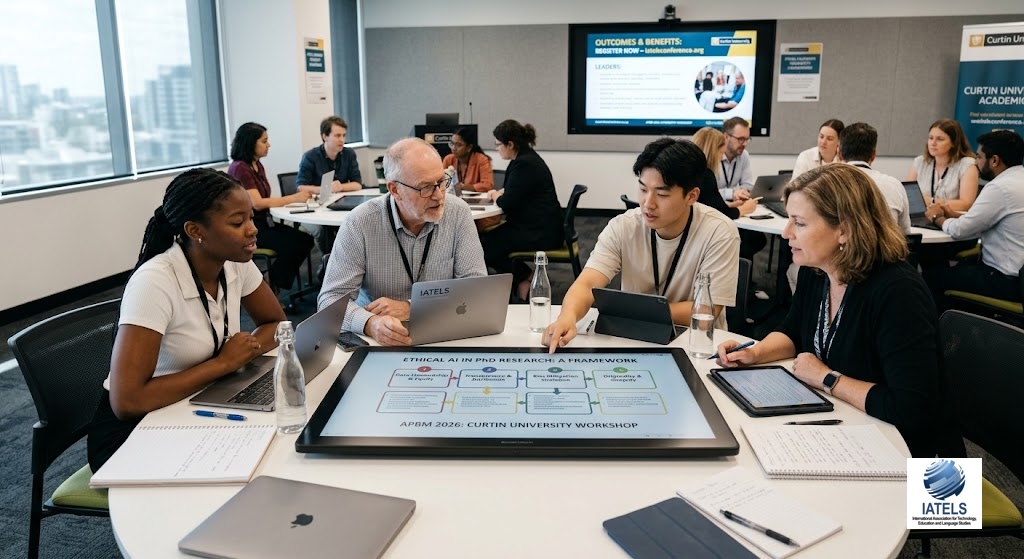
APBM 2026 Workshops: Ethical Use of AI in PhD Research
Following the outstanding success of our doctoral development workshop, “The Architect of Inquiry: Strategy, Resilience, and Success in the Modern PhD” at ICET 2026, IATELS is proud to scale and evolve this vital training initiative.
Integrated within the official program of the 6th International Conference on Applied Psychology and Business Management (APBM 2026), we are introducing a highly critical, specialized workshop designed to address the most profound disruption in modern higher education.
We are pleased to announce that this workshop will be led by senior academicians from Curtin University, Australia, bringing world-class institutional frameworks and global research standards directly to our participants.
A Specialized Training and Strategy Session for PhD Candidates, Supervisors, and Academic Researchers
Main Aims
The primary objective of this workshop is to move past basic tool-use tutorials and establish a rigorous, standardized, and ethically sound methodology for integrating Artificial Intelligence into doctoral-level inquiry. The workshop specifically aims to:
-
Define Boundaries: Establish clear lines between legitimate AI-assisted research acceleration (e.g., literature mapping, grammar refinement) and academic misconduct (e.g., algorithmic plagiarism, unverified data generation).
-
Calibrate the Supervisor-Candidate Dynamic: Provide actionable frameworks for PhD supervisors to guide, audit, and evaluate candidates who utilize generative AI models in their dissertations.
-
Preserve Scientific Rigor: Equip researchers with validation protocols to ensure AI outputs do not compromise the integrity, originality, and empirical reliability of their peer-reviewed contributions.
Workshop Structure & Core Modules
The session is systematically divided into three interconnected modules designed to address the separate but overlapping responsibilities of candidates and institutional evaluators:
Module 1: The AI-Assisted Literature Review & Synthesis
-
Focused on utilizing machine learning tools for systematic mapping, trend discovery, and academic deep-scanning while maintaining intellectual ownership and avoiding echo-chamber biases.
Module 2: Algorithmic Integrity & Data Methodology
-
Investigating the ethics of using AI for qualitative coding, quantitative parsing, and drafting. Special emphasis is placed on data privacy, copyright constraints, and the catastrophic risk of AI “hallucinations” in scientific reporting.
Module 3: Policy, Transparency, and Disclosure Frameworks
-
Developing a universal template for researchers to transparently declare and document their AI use to publishers, ethical clearance boards, and university thesis defense committees.
Main Questions for Discussion
The workshop participants will engage in structured panel debates, case-study analyses, and interactive roundtables centered around these vital institutional questions:
-
Where does human authorship end and algorithmic contribution begin? Defining the exact threshold of originality in a dissertation assisted by large language models.
-
How must the role of the PhD Supervisor adapt? Shifting from traditional text-checking to advanced methodological auditing and cognitive guidance.
-
The Bias and Privacy Dilemma: How can researchers upload proprietary empirical data or sensitive qualitative interview transcripts into commercial AI models without breaching strict institutional ethics boards (IRB) guidelines?
-
Combating Algorithmic Deskilling: How do we ensure that early-career researchers retain critical thinking, deep reading capacities, and independent synthesis skills when optimization tools automate structural tasks?
Workshop Outcomes and Benefits for the Participants
For PhD Students & Candidates:
-
Methodological Clarity: Walk away with a customized, safe “AI Protocol Blueprint” that protects your dissertation from accidental plagiarism allegations or ethical flags.
-
Skill Acceleration: Learn to safely compress the time spent on administrative data sorting, allowing you to focus your cognitive energy on high-level analysis and original argumentation.
For PhD Supervisors & Principal Investigators:
-
Auditing Toolkits: Receive concrete evaluation rubrics and conversation frameworks to objectively assess the integrity of a candidate’s draft submissions.
-
Policy Alignment: Align your laboratory or department’s research output with the emerging AI compliance standards of major international indexing bodies (such as Scopus, Web of Science, and Springer).
For Institutional Researchers:
-
Global Benchmarking: Access the exact policy models and compliance methodologies currently deployed within top-tier Australian higher education ecosystems via our leaders from Curtin University.
-
Certified Training: All registered participants will receive an official IATELS Professional Development Certificate, documenting their training in Research Ethics and AI Methodology.
Registration Notice & Invitation
As space for this interactive, hands-on workshop within the APBM 2026 cycle is strictly capped to ensure direct mentorship from our Curtin University facilitators, early institutional booking is highly encouraged.
-
Target Audience: Current PhD candidates, doctoral supervisors, university research directors, academic editors, and post-doctoral fellows.
-
Delivery Matrix: Fully interactive, live online workshop with downloadable resource kits and policy templates.
🔗 Secure Your Seat: Registration pipelines, abstract submission alignments, and complete event timing schedules are managed directly through the central conference gateway.
Ensure your participation by visiting the official portal: https://iatelsconference.org/apbm-2026-7th-international-conference-on-applied-psychology-and-business-management/
You can start your registration by filling out the form and noting your intentions to join the workshop (Note: “Doctoral Workshop Track – AI in PhD Research” in your registration form).

Assoc. Prof., Dr. Tomayess Issa
Curtin University, Australia
“Following the profound engagement and deep scholarly dialogue we experienced during our doctoral workshop at ICET 2026, it became clear that our global academic community is currently navigating a critical turning point. While our previous sessions successfully fortified the foundations of doctoral strategy and resilience, the meteoric rise of generative technologies demands that we urgently confront a new operational frontier: the ethical orchestration of AI in high-level scientific inquiry. This upcoming workshop at APBM 2026 is born directly out of that national and international necessity, moving far beyond basic software tutorials to establish rigorous, transparent boundaries for original authorship. It is no longer a question of whether artificial intelligence will reshape higher education, but how rapidly we can equip candidates and supervisors with the critical methodologies needed to protect intellectual integrity. I look forward to leading this essential collaborative laboratory, where we will actively bridge the gap between technological acceleration and human academic responsibility to establish the new global benchmarks for doctoral excellence.”






Leave a Reply