
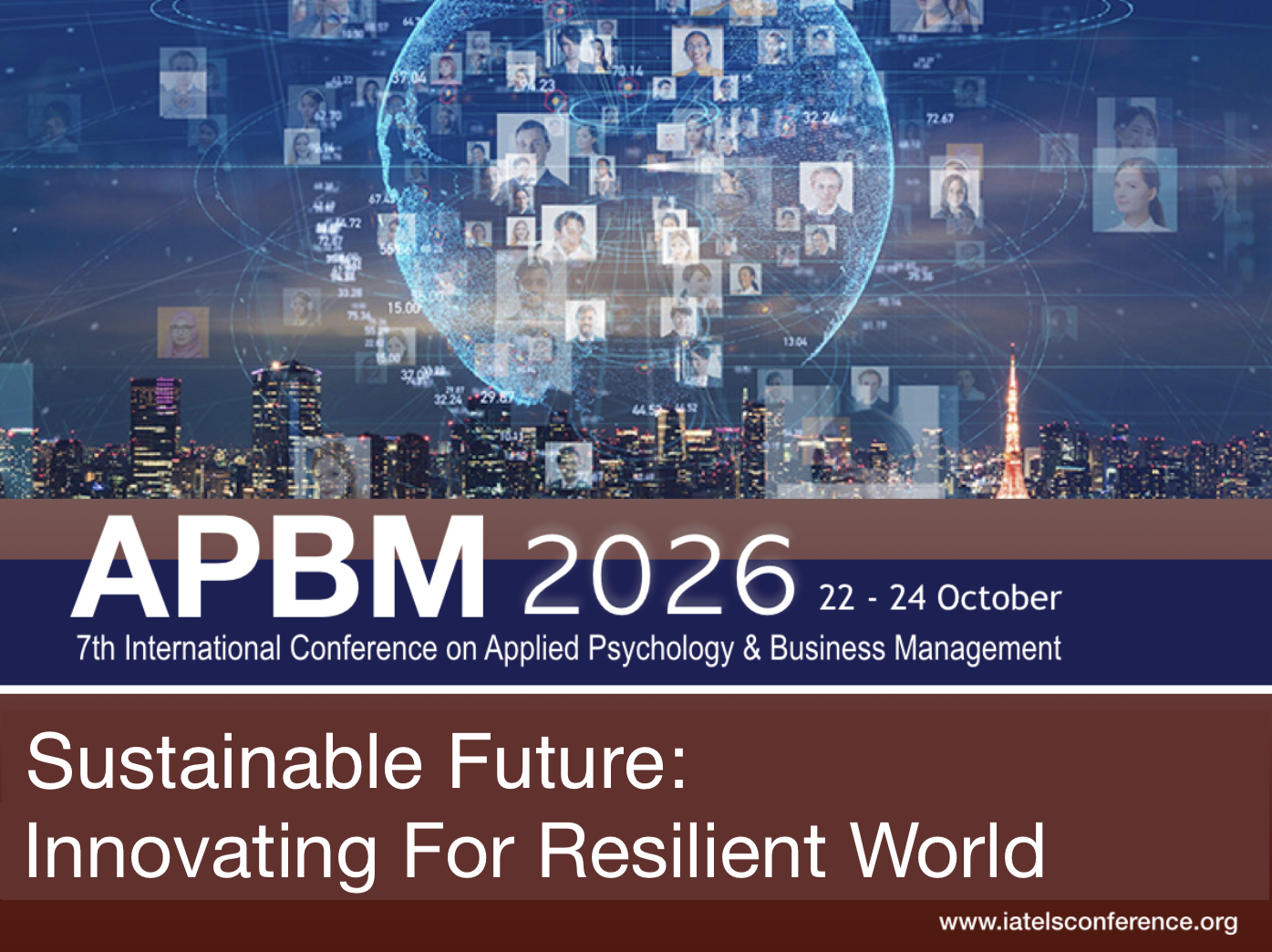
APBM 2026: Sustainability, Business, and Human Agency in the AI Era
New Horizons in Applied Psychology and Strategic Business Development
Registration Deadline: 10 of October, 2026
The International Association for Technology, Education and Language Studies (IATELS) is proud to officially announce the core topic and concept framework for the 7th International Conference on Applied Psychology and Business Management (APBM 2026).
Our selection of this year’s main theme—Sustainability, Business, and Human Agency in the AI Era—is a deliberate response to the most critical national and international challenges facing modern society.
This conference concept is conditioned by three urgent, interlocking forces that dictate the current global landscape:
-
Economic Urgencies: Fluctuating global markets, changing cross-border trade legalities, a shift from linear corporate models to circular, green economies require companies to rapidly build new, sustainable competitive advantages just to maintain profitability.
-
Practical Urgencies: The massive, rapid deployment of Artificial Intelligence across industries has triggered severe operational friction. Organizations are facing deep practical bottlenecks, from widespread employee “AI anxiety” and mental burnout to immediate compliance demands for international ESG (Environmental, Social, and Governance) data.
-
Research Urgencies: Traditional organizational psychology and management theories are currently facing an unprecedented gap. There is an immediate, critical need for rigorous empirical studies that analyze how human cognitive architectures, behavioral adaptation, and identity evolve when paired with advanced automated workflows.
To address these compounding societal needs, share ongoing experiences, debate current institutional practices, and engineer innovative solutions, APBM 2026 serves as a highly targeted collaborative gateway bridging international academia and active business execution.
We hereby invite university leaders, senior scholars, human resource architects, corporate consultants, and industry practitioners to submit their latest research, case studies, and methodologies across the following five core scientific tracks that define our 2026 program:
APBM 2026 introduces a vital, prospective evolution. For this edition, we declare Sustainability as our foundational, cross-cutting key topic.
APBM 2026 reframes it entirely through the concurrent lenses of Applied Psychology and Strategic Business Development—investigating the cognitive preservation of our workforce, the security of human agency, and the acceleration of corporate velocity, market scalability, and competitive advantage in an AI-driven, highly volatile global economy.
APBM 2026 Core Program Architecture & Scientific Tracks
To address these dual crises, the scientific committee has structured the APBM 2026 program into five interconnected, high-yield thematic tracks. We invite submissions that address the academic and practical urgencies detailed below.
Track 1: New Horizons in Applied Psychology and Strategic Enterprise Growth
-
The Academic Urgency: Traditional organizational psychology models are failing to explain workforce behavior under the rapid, compounding pressures of automated scaling. Researchers must establish new empirical frameworks to study how cognitive architectures adapt when business models transform at exponential speeds.
-
The Practical Urgency: Companies attempting to scale rapidly in volatile markets are hitting severe bottlenecks due to human friction, operational resistance, and strategic misalignment. Business leaders need data-driven methodologies to synchronize human capital with aggressive growth targets.
Targeted Subtopics:
-
-
Psychological drivers of high-velocity scaling and hyper-growth corporate dynamics.
-
Behavioral metrics and psychological assessment tools for predicting cross-border venture success.
-
Cognitive economics of market dominance and high-stakes executive decision-making under uncertainty.
-
Synthesizing professional identity, personal purpose, and corporate evolution in decentralized markets.
-
Track 2: Shifting Paradigms in Behavior, Technology, and Adaptive Management
-
The Academic Urgency: The intersection of human behavior and artificial intelligence requires immediate, rigorous socio-technical investigation. Academia must move past superficial impact studies to analyze the deep behavioral shifts, algorithmic biases, and fundamental alterations in human agency occurring within digitized workspaces.
-
The Practical Urgency: Blindly adopting AI tools without understanding human behavioral feedback loops is decimating team cohesion, creating operational vulnerabilities, and triggering massive “AI anxiety.” Managers must learn to build socio-technical systems where automated efficiency enhances, rather than suppresses, human capability.
Targeted Subtopics:
-
-
The psychology of Generative AI and human agency: Managing cognitive offloading and protecting creative ownership.
-
Algorithmic governance, predictive analytics, and behavioral transparency vs. employee trust.
-
Socio-technical workspace design for hybrid, remote, and AI-integrated team ecosystems.
-
Cognitive load optimization and preventing attention fragmentation and digital burnout among knowledge workers.
-
Track 3: Advancements in Applied Psychology and Resilient Corporate Leadership
-
The Academic Urgency: The definition of leadership is undergoing a fundamental transformation. Researchers need to deconstruct legacy hierarchical power dynamics and investigate the neuroscientific and psychological components of resilience, agility, and systemic empathy required to lead highly volatile, distributed international institutions.
-
The Practical Urgency: Modern executives are operating in a permanent state of crisis management—navigating geopolitical supply shocks, rapid market shifts, and acute organizational anxiety. Standard management training is obsolete; leaders require immediate, actionable psychological frameworks to maintain emotional regulation, execute clear strategy under pressure, and insulate their organizations from external shock waves.
Targeted Subtopics:
-
-
Neuro-leadership and high-stakes decision-making: Applying cognitive neuroscience to executive risk assessment.
-
Psychological insulation frameworks for building resilient institutional cultures during industry disruptions.
-
Diplomatic mediation, cross-border conflict resolution, and aligning multi-stakeholder boards.
-
The agility mandate: Transforming top-down corporate governance into decentralized, adaptive networks.
-
Track 4: Innovating Human Capital and Sustainable Business Architecture
-
The Academic Urgency: There is a critical research gap in translating abstract macroeconomic sustainability goals (like ESG or the circular economy) into micro-level organizational behavior. Scholars must define how business architectures can be designed to treat both environmental and human resources as renewable, self-sustaining assets.
-
The Practical Urgency: Institutional investors and global regulators are demanding verifiable, transparent sustainability metrics, while modern workforces are abandoning companies that exploit human talent. Organizations must completely redesign their corporate architecture to ensure that environmental compliance and employee well-being directly drive corporate profitability, rather than costing it.
Targeted Subtopics:
-
-
Human capital as a renewable resource: Redesigning HR metrics and performance evaluation.
-
Hard ESG data modeling and integrating machine learning with behavioral sustainability analytics.
-
The circular enterprise blueprint: Shifting linear workflows into efficient, closed-loop operational systems.
-
Green intellectual capital: Fostering, protecting, and commercializing eco-innovations and clean-tech patents.
-
Track 5: Sustainability and Business Development in the AI Era
-
The Academic Urgency: There is an immediate need to theorize new macroeconomic and microeconomic models where AI acts as the primary catalyst for sustainable development. Scholars must investigate how machine learning algorithms can optimize global resource allocation, predict market shifts, and foster equitable, green business growth without causing technological displacement or systemic ecological footprints.
-
The Practical Urgency: Modern corporations cannot scale globally without AI, nor can they secure premium market investments without meeting rigorous green compliance standards. Business developers must learn to stop viewing AI and sustainability as conflicting mandates, and instead use intelligent automation as a direct engine for uncovering green revenue streams, capturing eco-conscious market shares, and driving aggressive, sustainable business expansion.
Targeted Subtopics:
-
-
AI-driven green market penetration: Utilizing predictive analytics to identify emerging international sustainable markets.
-
Algorithmic resource optimization: Deploying deep-learning models to scale operations while minimizing carbon footprints.
-
Sustainable tech infrastructure: Managing the physical energy consumption and carbon costs of corporate AI networks.
-
Automated ESG compliance: Leveraging AI tools to track cross-border regulatory frameworks and automate carbon accounting.
-
AI-enabled circular value creation: Transforming internal corporate waste lines into profitable, closed-loop sub-ventures.
-
Track 7: IIntelligent Systems, Automation & Systems Engineering (Engineering & Technology)
-
The Academic Urgency: Engineering frameworks must advance beyond mere technical capacity to theorize socio-technical systems where artificial intelligence explicitly adapts to human cognitive constraints and systemic safety protocols.
-
The Practical Urgency: Tech executives and engineers face immense pressure to design, audit, and deploy machine learning pipelines that are operationally efficient, algorithmically transparent, and physically energy-sustainable.
Targeted Subtopics:
-
-
Sustainable AI infrastructure: Engineering solutions to manage the energy and carbon costs of data networks.
-
Algorithmic governance, transparency protocols, and predictive data analytics in complex workflows.
-
Human-in-the-loop (HITL) engineering architectures for manufacturing, logistics, and supply chains.
-
Automated system validation, machine learning auditing, and technological risk mitigation frameworks.
-
Track 6: Strategic Enterprise Growth & Macroeconomics (Business Management & Economics)
-
The Academic Urgency: Global economic volatility and shifting trade frameworks require new macroeconomic theories to explain how enterprises can scale sustainably without inducing market instability or structural resource depletion.
-
The Practical Urgency: Corporate decision-makers and business developers are struggling to turn strict sustainability mandates and ESG compliance into profitable, high-rate growth engines and scalable business architectures rather than financial burdens.
Targeted Subtopics:
-
-
Circular economics, closed-loop value chains, and sustainable corporate finance models.
-
Venture scalability, international trade development, and predictive behavioral economics for market entry.
-
Transforming ESG metrics from compliance requirements into direct corporate revenue streams.
-
Agility networks in corporate governance: Shifting away from rigid, legacy management frameworks.
-
Track 8: Socio-Technical Workspaces & Digital Sociology (Social Studies & Applied Psychology)
-
The Academic Urgency: The hyper-digitalization of the global workforce requires deep sociological and psychological investigation into how societal structures, cultural identity, and human behavior are fundamentally altered when paired with automation.
-
The Practical Urgency: Organizations are hitting massive operational bottlenecks caused by cultural resistance, “AI anxiety,” and severe cognitive overload among remote, hybrid, and cross-border teams.
Targeted Subtopics:
-
-
The sociology of the automated workspace: How AI impacts professional identity and social cohesion.
-
Cognitive ergonomics, mental fatigue prevention, and protecting human agency in tech-intensive sectors.
-
Re-engineering HR architectures to treat human capital as a renewable, self-sustaining resource.
-
Cross-cultural team dynamics and behavioral alignment during high-velocity international scaling.
-
Please feel free to submit your abstract even if your specific topic does not fall directly within the enumerated tracks and themes above; APBM 2026 remains a fully open platform for multidisciplinary, practical, and fundamental research that drives innovation and societal progress.
The Synergy Focus: Where Behavior Meets Strategy
The highest unique value of APBM 2026 lies at the intersection of our core disciplines. We highly encourage abstract submissions that explicitly bridge the psychological functioning of the workforce with active corporate expansion strategies, focusing heavily on:
-
Sustainable Corporate Cultures & Human Capital Governance
-
Brand Authenticity, Green Marketing, and Consumer Trust
-
Strategic Mediation and International Cohesion
Expected Outcomes & High-Rate Publishing Opportunities
Participants within the APBM 2026 cycle will benefit from distinct, verified academic and professional output pipelines designed to maximize research impact:
-
ISBN-Indexed Publication: All accepted, peer-reviewed abstracts will be archived and published in the official APBM 2026 Conference Book of Abstracts.
-
International Monograph Selection: High-quality, structurally rigorous peer-reviewed papers will be selected for submission within our collaborative book monograph proposals with international publishing houses.
-
Thematic Research Clusters: Selected participants will be invited to form international, cross-border academic-industry clusters focused on delivering strategic policy recommendations for human-centered corporate design and further collaborative frameworks.
Join APBM 2026 Global Dialogue
APBM 2026 will be delivered as a fully interactive, online international event, maximizing global accessibility for scholars, business consultants, and institutional practitioners alike. The event features interactive keynotes, specialized research tracks, expert panel debates, workshops and strategic collaboration roundtables.
-
Abstract Submission Cycle & Guidelines: Available on the main submission gateway.
-
Acceptance Notifications: Within 10 days after the abstract submission.
-
Main Conference Workshops and Special Topic Tracks: Workshops for PhD students, Round table discussions and Open Class from Curtin University (Australia).
🔗 Official Registration and Submissions Notice:
For more details, specific abstract submission guidelines, please refer directly to the main APBM 2026 Conference page: https://iatelsconference.org/apbm-2026-7th-international-conference-on-applied-psychology-and-business-management/
The registration requirements can be checked at the link https://iatelsconference.org/registration/.
APBM 2026 Special Workshops and Practical Sessions
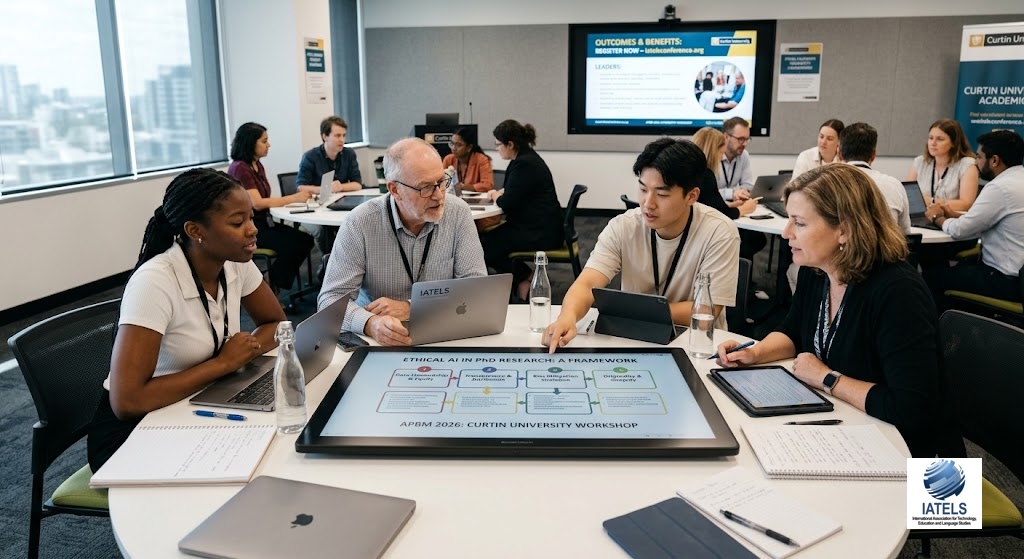
APBM 2026 Workshops: Ethical Use of AI in PhD Research
The primary objective of this workshop is to move past basic tool-use tutorials and establish a rigorous, standardized, and ethically sound methodology for integrating Artificial Intelligence into PhD level inquiry.
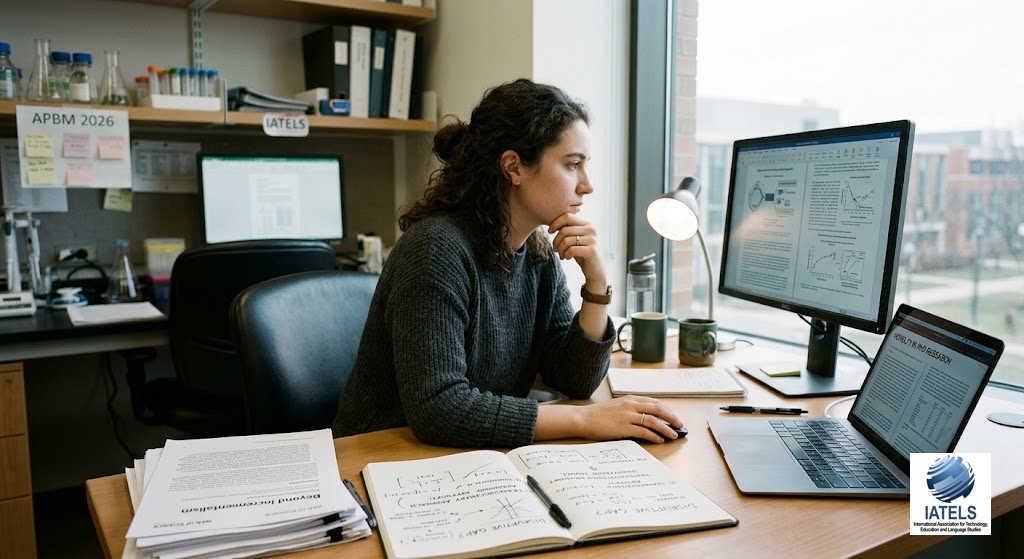
APBM 2026 Workshops: Novelty in PhD Research
How to Make Your Study Truly Innovative When Everything Has Already Been Explored? This workshop is designed to transition researchers away from defensive, “gap-filling” and elevate them into high-impact strategists.

APBM 2025 Sustainability Collision Lab: Theory Meets Practice
The primary objective of the Sustainability Collision Lab is to reconcile the divergence between theoretical research and corporate execution.
The session is designed to pressure-test academic models under real-world economic conditions, while simultaneously providing business managers with scientifically verified frameworks to guide their sustainability strategies.
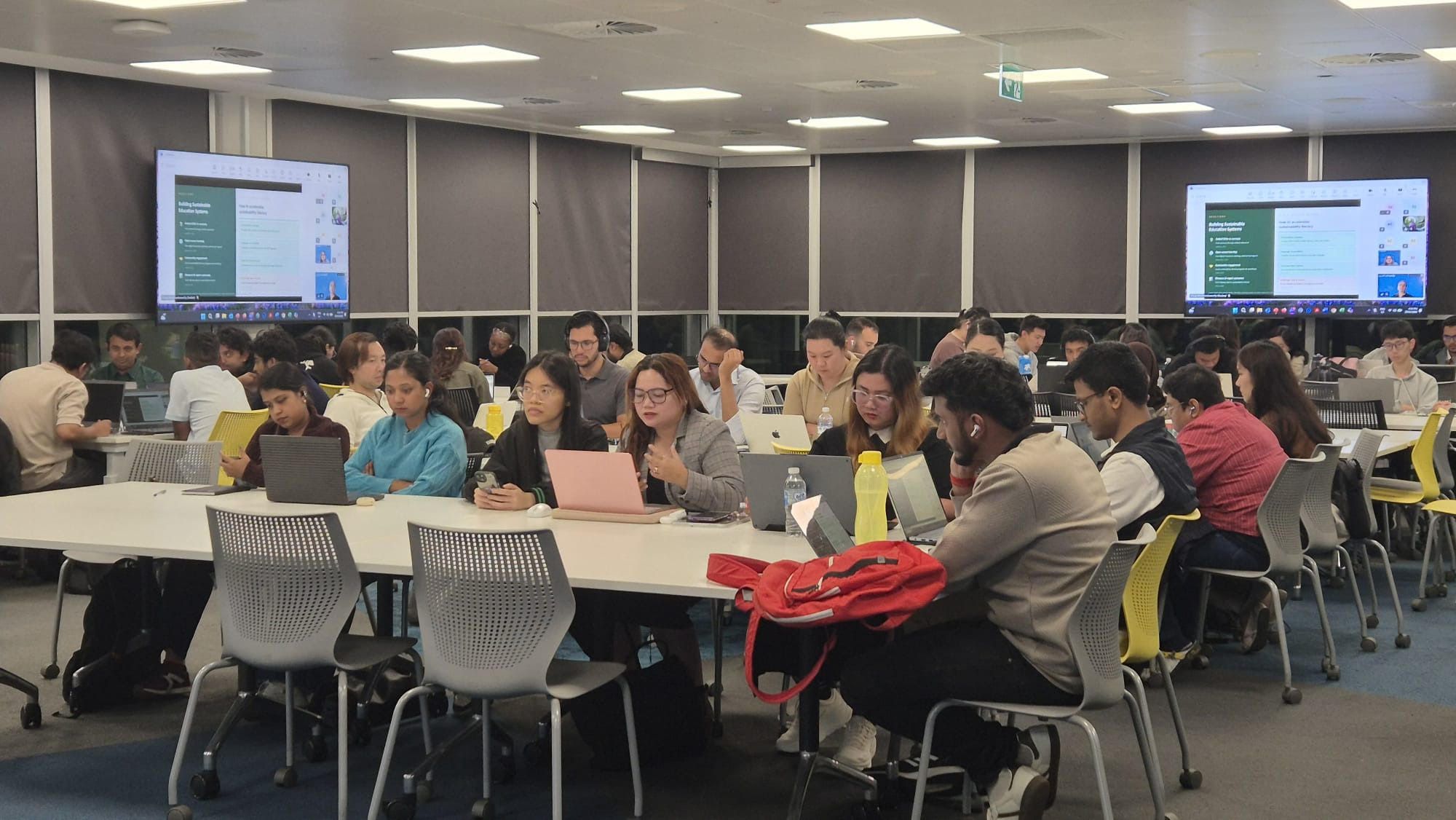
From Perth to the World: The Curtin University Live Classroom Stream at APBM 2026
This specialized stream bypasses conventional presentation paradigms, offering participants an authentic, unedited window into top-tier Australian higher education ecosystems as they tackle the complexities of sustainable management, organizational psychology, and technologically driven business environments.






Leave a Reply